
There is a strange, almost silent shift in how attention is distributed today. It was never announced, never debated, no manifesto was written. It simply happened – and now we all live inside it.
In this world, art still exists, but it increasingly has to justify why it exists at all.
Not why it is good – but why it deserves any time whatsoever.
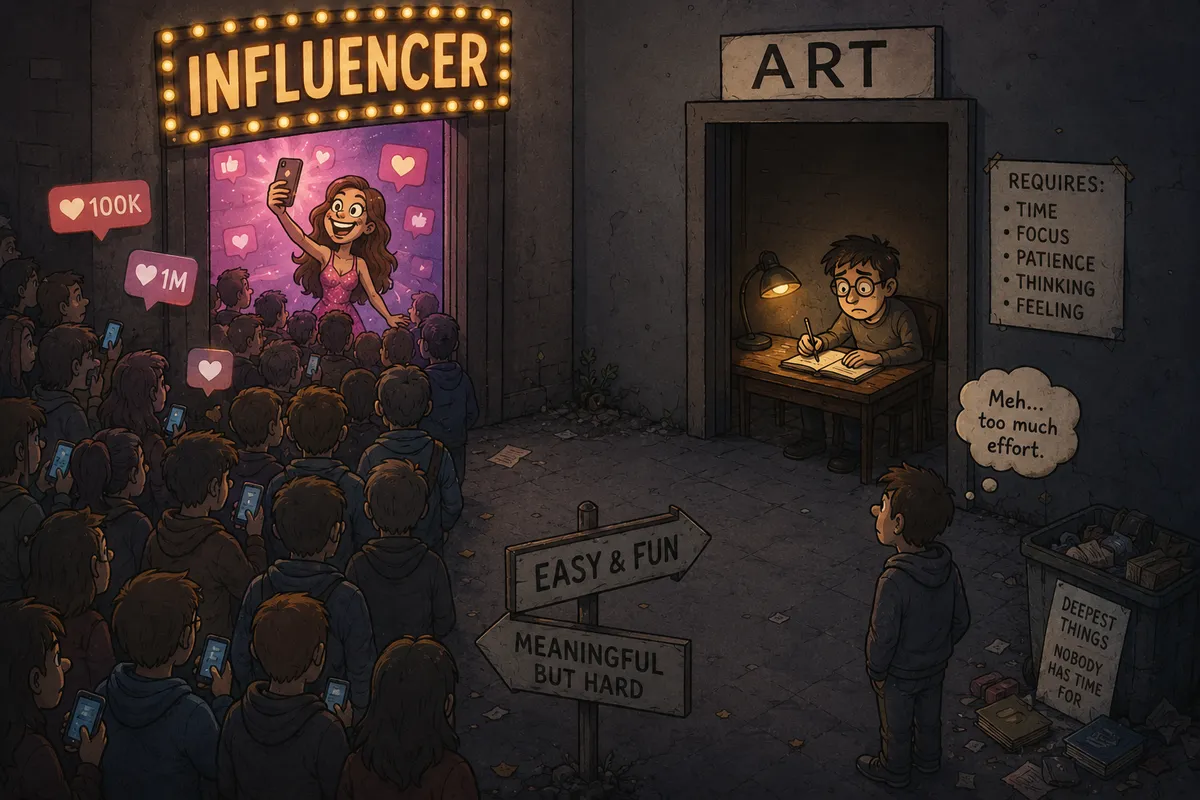
Because time is no longer the natural backdrop of life, but a resource that must be “optimized.” And within that optimization, everything slowly gets divided into two categories: what gives immediate sensation, and what requires inner effort.
Guess which one survives better.
The modern generation is not anti-art. On the contrary – it loves “creativity.” It loves aesthetics, moods, vibes, visual comfort. But only if all of it comes without resistance, without silence, without that uncomfortable moment where you don’t immediately understand and have to stay with it.
Patience has become a suspicious quality.
And what is suspicious is not consumed.
In this new order, depth is often seen as complication rather than value. If something takes more than a few seconds, it starts losing competitiveness – not because it is bad, but because it is slow.
And slowness has almost become a moral flaw.
The irony is that no one declared war on art. We simply shifted the center of gravity – from the inner to the immediate, from accumulation to reaction, from understanding to recognition.
Now it is enough for something to be “recognizable” in order to be accepted. It does not need to be understood.
And so a new culture slowly emerges – a culture of instant legibility, where complexity is not forbidden, just… unnecessary.
Not because people are incapable of understanding it, but because the system no longer rewards it.
And here comes the quietest part of the transformation:
people begin adapting not to what they love, but to what works.
Eventually, even their own tastes start sounding like a compromise between attention and effort.
And yet – strangely – art does not disappear.
It simply becomes slightly irrational behavior.
To write a long text.
To stay with an idea that does not reveal itself immediately.
To create something that offers no instant reward.
This is no longer the norm. It is almost an act of dissent.
And perhaps it is precisely there, in this small zone of “uselessness,” that art remains alive. Not because it wins attention, but because it refuses to shrink to it.
And the generation that supposedly “has no time” is in fact surrounded by more content than ever – but less of it remains.
Everything happens. Little of it stays.
And maybe that is the most accurate definition of the time we live in.