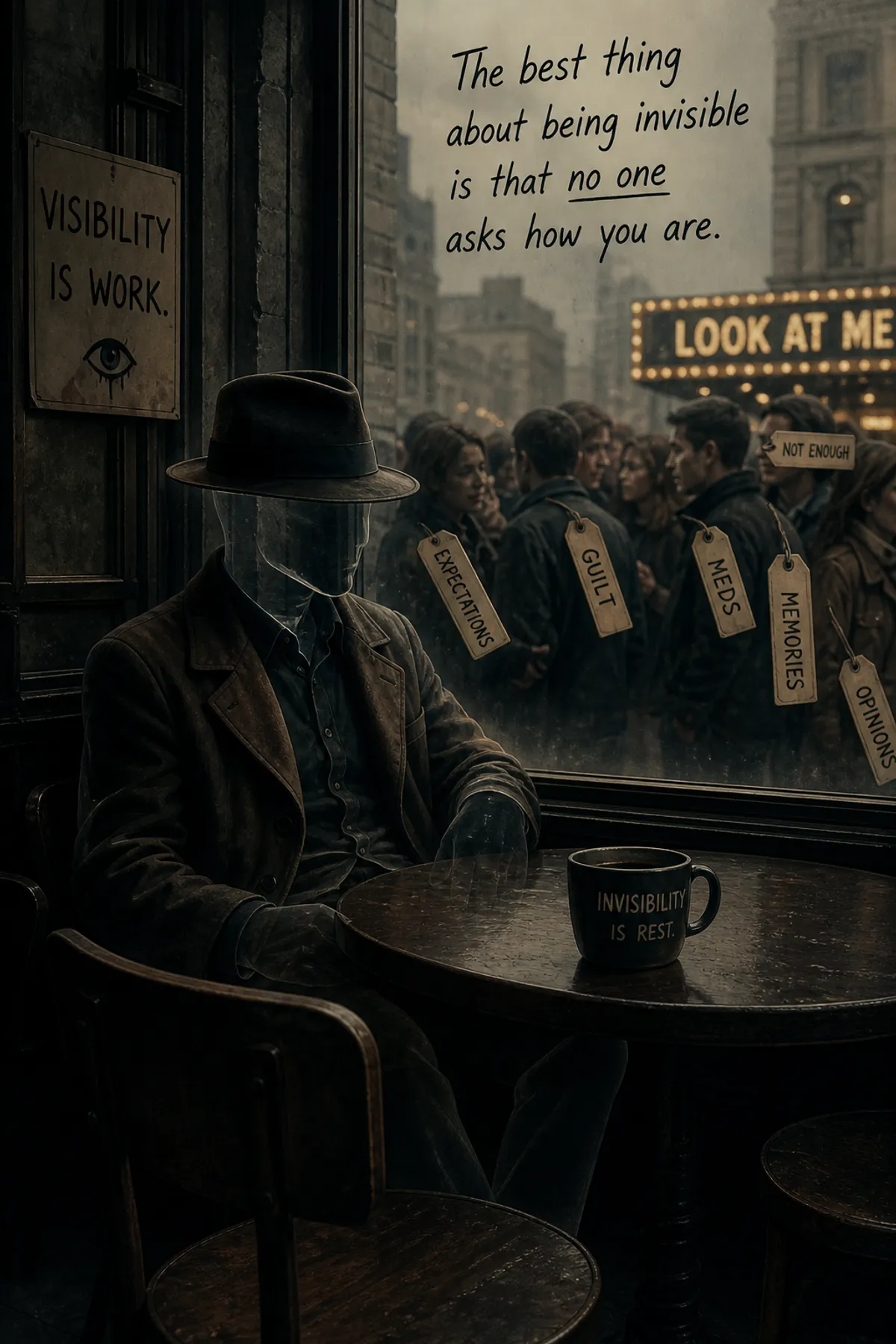

The best thing about being invisible is that no one asks how you are.
Not because they don’t care. But because they don’t know you exist.
And that is a huge, underrated privilege.
You wake up in the morning, drink your coffee, look out the window, and the world goes on without having an opinion about you. No expectations. No “you should.” No “why you.” No “you again.”
Just air.
When you are visible, people use you like a hanger. For emotions, for guilt, for desires, for needs, for memories, for unfinished exes, for mothers, for fathers, for gods, for demons. Someone is always trying to hang something on you. Even if they don’t know you.
When you are invisible — there are no hooks.
You can walk past someone and they load nothing onto you. This is a form of freedom no books are written about. Because authors usually want to be seen.
The invisible person has no audience. And therefore, no role. No need to be interesting. No need to be good. No need to be bad. No need to be anything.
You can simply be.
The most dangerous thing for a person is to be noticed. The moment someone sees you, they start inventing a version of you. And then you spend your whole life trying not to disappoint someone’s invention.
The invisible person is free from biographies.
No one remembers when they were wrong. No one remembers how they looked. No one remembers what they said. No one expects anything from them.
That is luxury.
To not be a factor in anyone’s story.
To not be important.
To not be a topic.
To not belong to anyone.
To be the air between two bodies, not one of them.
And the best part — you get to watch people struggle to be seen. How they push themselves to shine, to shout, to prove, to display, to explain. They want light. They want a spotlight. They want a stage.
And you are in the dark, leaning against the wall, at peace. Because you know a secret they have not yet learned:
Visibility is work.
Invisibility is rest.
When no one sees you, no one can use you. When no one uses you, you begin to belong to yourself. And for the first time, you realize how loud you are inside. How many thoughts you have. How many desires. How many fears. How much hunger. How much loneliness.
The visible person drowns this out with other people’s voices.
The invisible one is forced to hear themselves.
That is why invisibility is not for the cowardly. It is for people who can endure the company of their own truth. And sometimes, in that darkness, you feel something strange: that maybe you never wanted to be loved. You only wanted not to be a burden.
And that is easiest to achieve when no one knows you are there.